Featured Optical & Cosmetic Packaging Solutions
Explore our certified turnkey product series, engineered specifically for global cosmetic lens distributors, beauty retailers, and private label optical brands.
Engineering Precision in Medical-Grade Cosmetic Contact Lens OEM
A comprehensive examination of polymer biophysics, automated cast molding, pigment micro-encapsulation, and global regulatory compliance architectures.
In the contemporary ophthalmic and aesthetic marketplace, sourcing custom OEM cosmetic contact lenses demands far more than basic pattern printing and bulk distribution. Contact lenses—whether non-corrective plano cosmetic units or optical corrective medical devices—are strictly regulated by international healthcare authorities including the United States Food and Drug Administration (FDA), the European Medical Device Regulation (EU MDR 2017/745), and the National Medical Products Administration (NMPA). Enterprise procurement teams face rigorous scrutiny regarding bio-compatibility, optical clarity, microbial sterility assurance levels, and pigment micro-leakage risks.
Shenzhen Lalens Co., Ltd (operating Lalens Factory) brings over 16 years of specialized contract manufacturing expertise, bridging the critical gap between high-fashion cosmetic eye trends and uncompromising medical-device safety. Operating Class 100,000 cleanroom facilities backed by ISO 13485-certified quality management protocols, our automated casting platforms ensure that every soft hydrogel lens achieves micron-level dimensional reproducibility across large batch runs.
Sandwich Bio-Encapsulation
Our proprietary 3-layer sandwich printing process isolates inorganic bio-pigments within the core hydrogel polymer matrix. Pigments never directly touch the corneal epithelium or conjunctiva, eliminating surface abrasion and toxic monomer migration risks completely.
Full-Mold Cast Polymerization
Utilizing precision optical steel tooling and specialized UV/thermal crosslinking stations, our cast molding maintains exceptional geometric repeatability. Edge profile geometries are designed via tangential profiling to promote tear-film circulation and ocular metabolic health.
End-to-End Lot Traceability
From incoming raw monomer synthesis (poly-HEMA, cross-linking agents, UV blockers) to final terminal moist-heat autoclave sterilization at 121°C, every production batch is logged under strict barcode tracking for comprehensive supply-chain auditability.
Comparative Analysis: Polymer Formulations & Printing Methodologies
Evaluating the trade-offs in oxygen transmissibility (Dk/t), surface lubricity, and chromatic stability for procurement specialists.
| Evaluation Parameter | Surface Pad Printing (Low Tier) | Lathe-Cut Hydrogel (Traditional) | Lalens Sandwich Cast Molding (OEM Grade) |
|---|---|---|---|
| Pigment Encapsulation | Exposed on inner/outer surface | Impregnated / manual tinting | Complete 3-Layer Interstitial Lock |
| Oxygen Transmissibility (Dk/t) | Obstructed by pigment binders (<10) | Moderate (12 - 18) | High (22 - 35+ depending on water content) |
| Corneal Friction Index | High roughness due to ink layer | Moderate machine striations | Ultra-smooth nano-molded edge profile |
| Batch Color Consistency | ΔE > 2.5 (Noticeable variance) | ΔE > 1.8 (Operator dependent) | ΔE < 0.8 (Computerized spectrophotometer) |
| Replacement Modality | Annual only | Quarterly / Annual | Daily Disposable, Monthly, and Annual |
| Regulatory Acceptance (US/EU) | Frequently rejected at customs | Requires individual registration | ISO 13485 & CE Certified, 510(k) Ready |
A critical consideration for brand owners is the biophysical relationship between water content and oxygen permeability. While higher equilibrium water content (EWC 55%) in poly-HEMA polymers provides immediate insertion comfort, it can accelerate tear film desiccation in dry air-conditioned or prolonged digital screen environments. Conversely, our 38% to 42% water formulations preserve ambient hydration balance, rendering them optimal for long-wear cosmetic usage, cosplay events, and theatrical applications without sacrificing corneal oxygenation.
Future Procurement Trends in Cosmetic Contact Lenses (2025–2030)
Anticipate shifting consumer demographics, regulatory escalations, and material innovations to stay ahead of competitive curves.
Daily Disposable Surge
Consumer preferences are accelerating away from annual lenses toward daily disposable (1-Day) modalities in the aesthetic segment. Eliminating multi-purpose chemical lens solutions minimizes microbial keratitis risks and boosts annual customer lifetime value (LTV).
Silicone Hydrogel (SiHy)
The transition from standard hydrogels to breathable silicone hydrogel materials represents the next cosmetic horizon. SiHy delivers Dk/t ratings exceeding 80, allowing prolonged 14-hour cosmetic wear without corneal hypoxia or peripheral vascularization.
Hyper-Natural Radial 3D Iris
Flat, high-contrast circular limbal rings are giving way to diffuse, multi-tonal bio-mimetic gradients. Advanced CMYK rasterized digital micro-dot matrices reproduce the human stroma, providing natural iris depth across varied ambient lighting.
Sustainable Blister Packaging
Major markets demand reduced single-use polypropylene waste. Lalens Factory is pioneering ultra-thin polypropylene blister foils and compact secondary packaging, cutting supply chain cubic volume and ocean carbon footprints by up to 32%.
Why Tier-1 Cosmetic Brands Partner with Shenzhen Lalens Co., Ltd
Combining vertically integrated casting facilities with dedicated private-label compliance support.
Comprehensive Private Label Kits
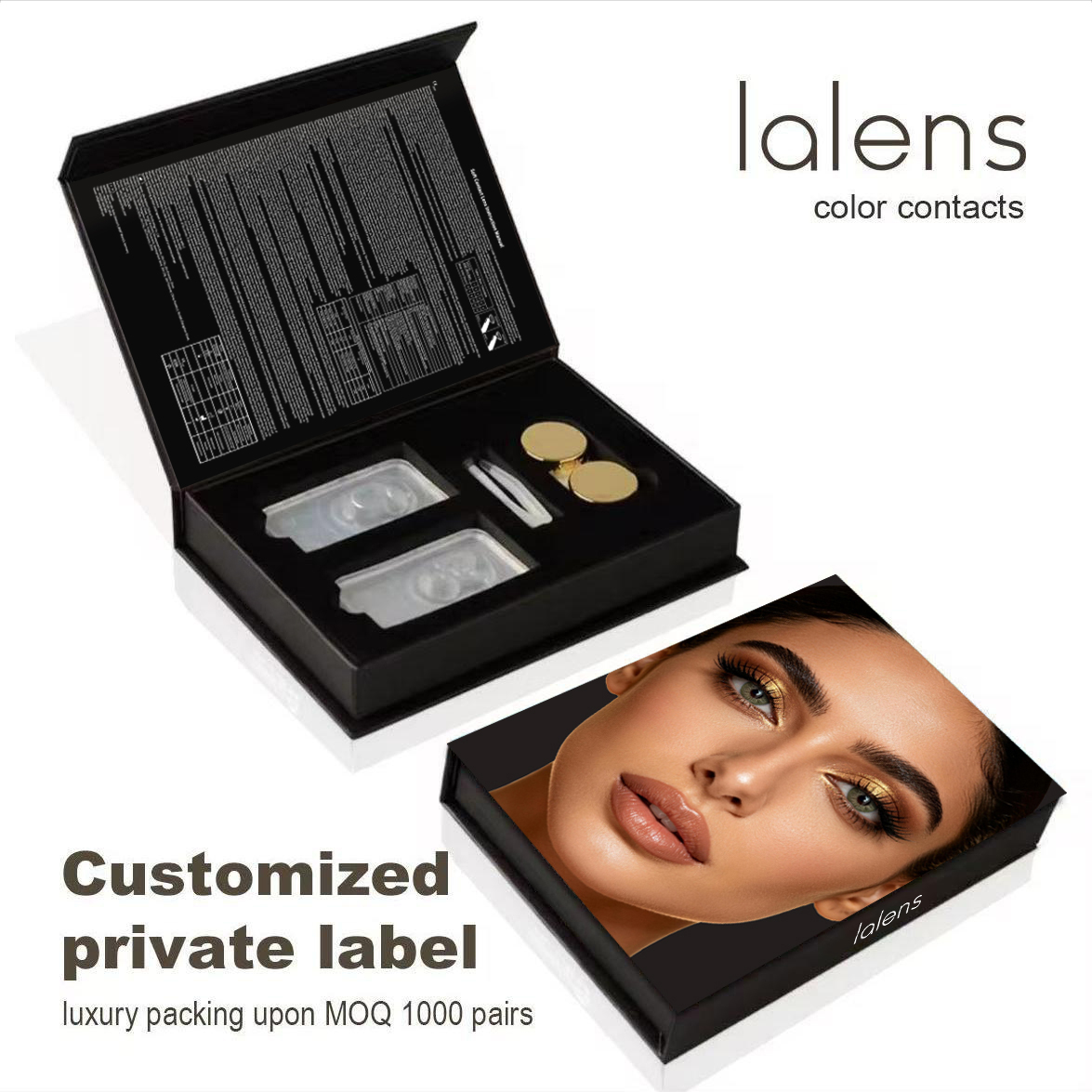
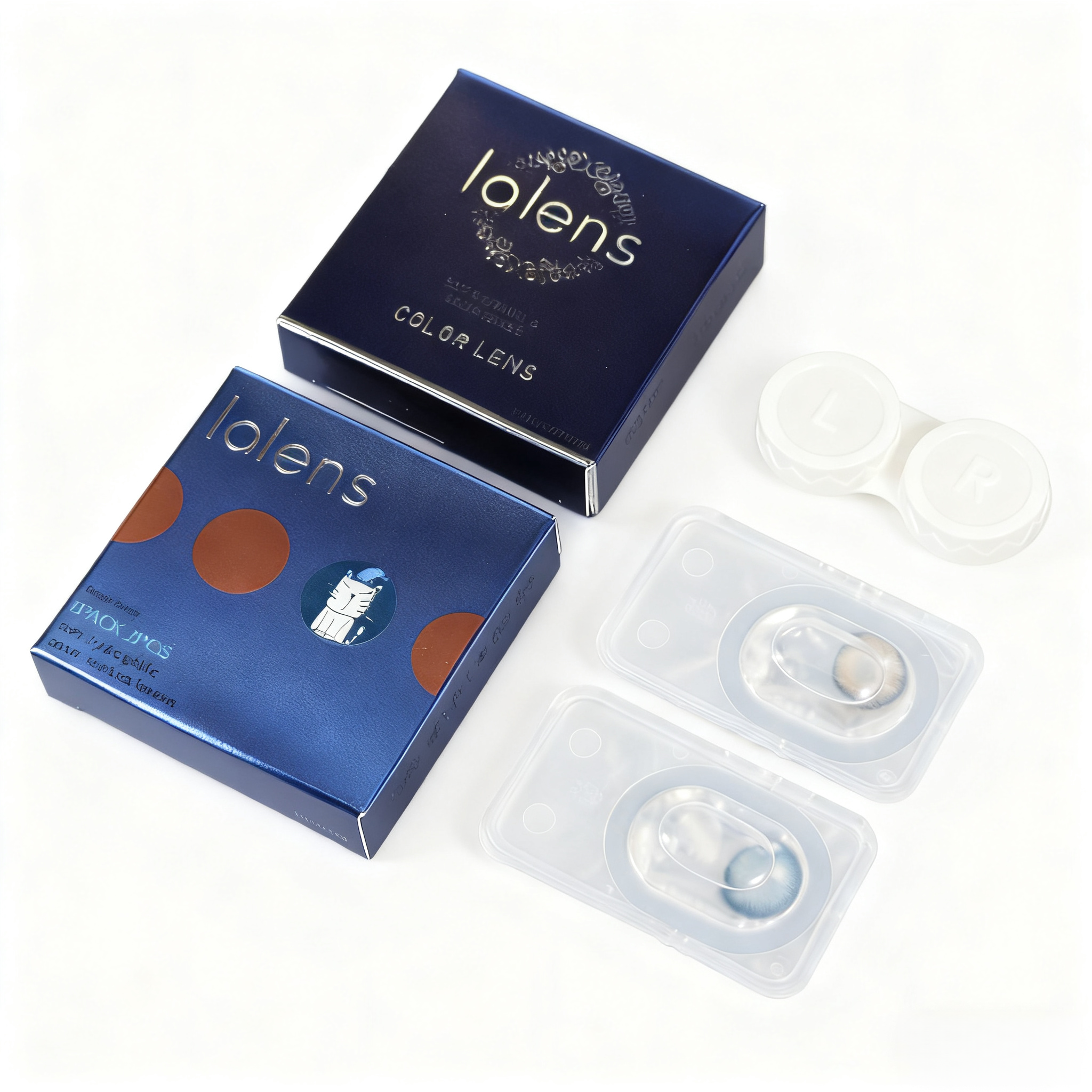
We deliver total turnkey OEM solutions: customized sterile PP blister packaging, high-barrier hermetic heat-seal aluminum lids, rigid display gift boxes, multilingual consumer instruction inserts (IFUs), and barcode/GS1-compliant exterior shipping cartons.
Plano to Corrective Diopter Range
Unlike factories restricted to non-prescription decorative lenses, our precision cast molding lines manufacture full prescription diopter spans from plano (0.00D) down to -10.00D in precise 0.25D and 0.50D increments, expanding your addressable consumer demographic.
Flexible Minimum Order Economics
We optimize capital allocation for emerging brands. In-stock rapid replenishment SKUs feature low MOQ starting from 100 pairs per colorway, while custom-designed exclusive iris patterns start at accessible thresholds with fast 25-35 day production turnaround times.
Navigating Global Regulatory Demands: FDA, EU MDR, and Beyond
Essential guidance for international distributors to ensure smooth customs clearance and compliant market placement.
A prevalent pitfall in international contact lens distribution is treating decorative lenses as standard cosmetics. In the United States, the Food and Drug Administration categorizes all contact lenses—regardless of optical power—as Class II or Class III medical devices subject to pre-market 510(k) notifications, device listing, and stringent labeling mandates. Furthermore, under the Federal Trade Commission (FTC) Contact Lens Rule, US-based sellers must verify valid patient prescriptions prior to fulfillment.
Our regulatory affairs division works closely with importers, assisting with technical file compilation, biological safety assessments under ISO 10993 (including systemic toxicity, ocular irritation, and in vitro cytotoxicity), and validated moist-heat sterilization protocols under ISO 17665. By guaranteeing pre-cleared documentation, Lalens Factory eliminates port-of-entry detentions and import alerts.
ISO 13485:2016 Certified
Comprehensive Medical Device Quality Management System governing all phases: design, raw material synthesis, cast polymerization, hydration, visual inspection, and sterile packaging validation.
CE Conformity Assessment
Fully audited under European medical device standards, ensuring unimpeded commercialization across European Union member states and aligned global health territories.
Sterility Assurance (SAL 10-6)
Terminal steam autoclave cycles calibrated to achieve a Sterility Assurance Level of one non-sterile unit per million, backed by real-time bioburden testing and challenge organism validation.
Frequently Asked Technical & Operational Questions
Detailed insights addressing the key operational, financial, and compliance inquiries from B2B wholesale buyers.
What are the legal compliance prerequisites for importing cosmetic contact lenses into the United States?
Under US federal law (the Medical Device User Fee and Modernization Act and the Fairness to Contact Lens Consumers Act), all contact lenses are medical devices. Sourcing entities must maintain valid FDA Establishment Registrations, assign a US Agent if operating foreign entities, ensure Device Listings are active, and furnish products with FDA-compliant labeling that includes mandatory "Rx-Only" statements, manufacturer details, base curve, diameter, power, lot numbers, and expiration dates. Lalens Factory provides all foundational technical files, sterilization documentation, and material safety data sheets (MSDS) necessary for seamless US clearance.
How does Lalens Factory prevent pigment leaching and color-induced corneal irritation?
Unlike budget manufacturers that spray pigment onto the surface of finished lenses, we employ an advanced Triple-Layer Sandwich Micro-Encapsulation process. Inorganic colorants (iron oxides, copper phthalocyanine, titanium dioxide) are printed onto an initial polymer substrate, sealed with an intermediary bonding layer, and fully enveloped by a protective biocompatible hydrogel front cover before thermal polymerization. The pigment layer is permanently embedded within the polymer network, preventing direct ocular exposure and preserving surface smoothness equivalent to clear corrective lenses.
What is the standard production lead time and minimum order quantity (MOQ) for custom private label programs?
For catalog in-stock iris designs utilizing standard secondary packaging, our MOQ starts at 100 pairs per colorway, shipping within 7 to 12 business days. For fully custom private label programs—including proprietary iris artwork printing, customized blister lidding foils, branded folding boxes, and user manual inserts—the typical MOQ is 1,000 to 3,000 pairs per design. Custom production cycles generally require 25 to 35 business days following final digital proof sign-off, with express door-to-door courier (DHL/FedEx/UPS) reaching North America and Europe in 5 to 8 business days.
Can your factory develop exclusive, proprietary iris patterns that will not be sold to competitors?
Yes. We offer structured Original Design Manufacturing (ODM) agreements with territorial exclusivity clauses. Our optical design department works directly with your brand team to formulate unique color palettes, limbal ring feathering, pupil aperture diameters, and stroma textures. Once an exclusive pattern is engineered and contractual volume commitments are agreed upon, that design is registered to your brand and strictly excluded from our open commercial wholesale catalogs.
What quality control protocols are implemented prior to shipping each production batch?
Every single batch undergoes rigorous four-stage quality assurance: (1) High-resolution optical projection inspection checking for edge defects, tears, bubbles, or pigment voids; (2) Automated focal-power mapping verifying diopter accuracy across optical zones; (3) Contact angle and water content titration tests measuring tear-film wettability and polymer equilibrium; and (4) Post-autoclave physical seal integrity and vacuum leak checks on 100% of blister packs. Certificate of Analysis (CoA) reports accompany every commercial release.
Accelerate Your Cosmetic Lens Brand Today
Partner with an ISO 13485-certified manufacturer equipped to scale with your volume. Request our complete wholesale catalog, technical whitepaper dossiers, or express sample kits.
Send an Inquiry